The backbone of global industrial supply chains
Transporting the raw materials that power global infrastructure, energy production, and agriculture
Classes
Distinct vessel categories defined by size, design and operational purpose.
Cargo
Representative major bulk commodities carried on long-haul trades.
Fleet size
Total number of vessels available within the global shipping fleet.
Trade
Approximate annual dry bulk cargo moved by sea.
Role in global trade
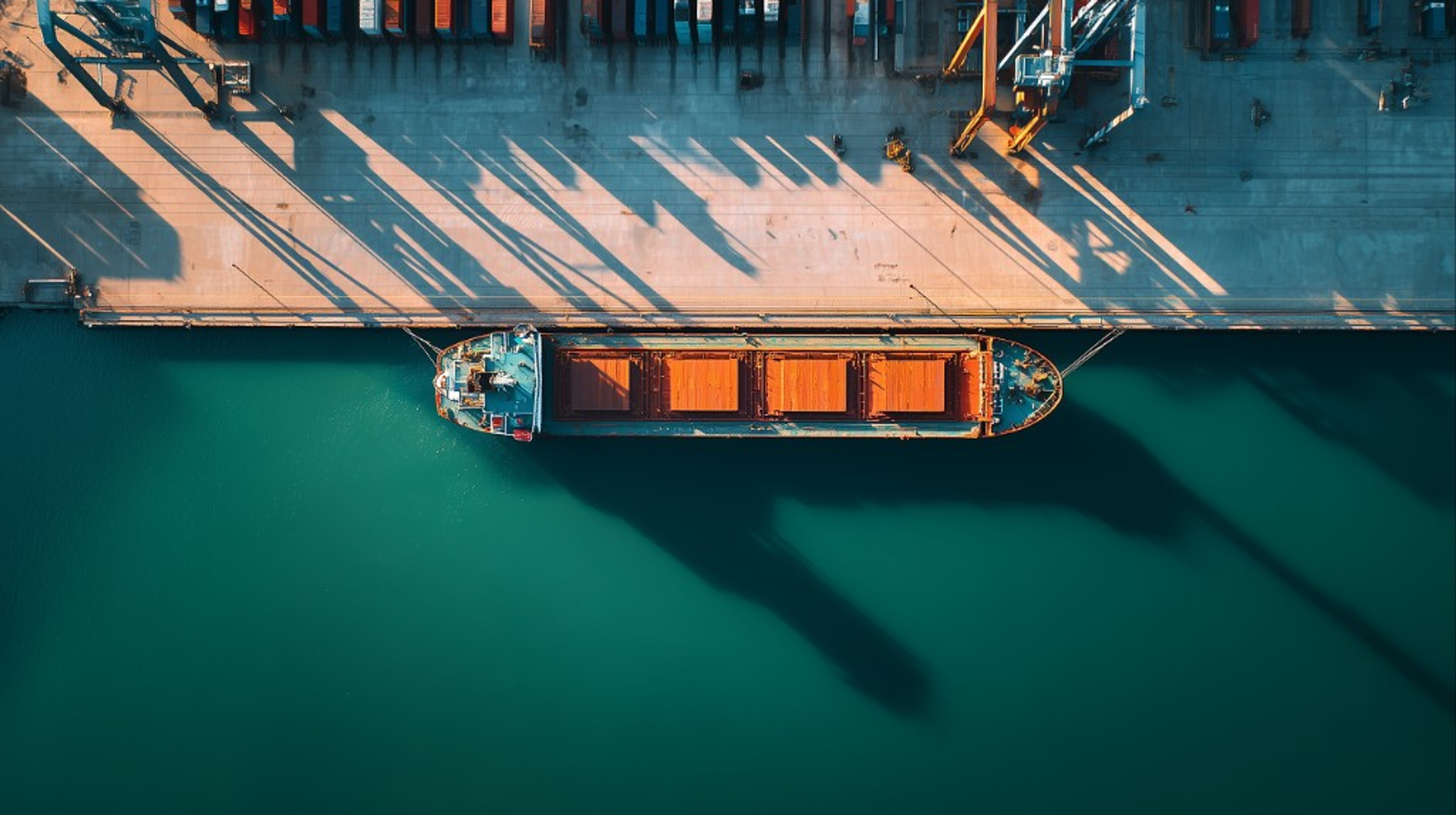
Dry bulk vessels are designed to transport large quantities of non-liquid commodities, typically carried unpackaged in their raw or unprocessed form. The sector plays a critical role in international trade as the most cost-efficient method of worldwide transportation of commodities that constitute essential inputs in steel production, energy generation, and agriculture.
Segments
Dry bulk vessels come in various sizes and configurations but are mainly classified based on their carrying capacity which is measured in deadweight tons ("DWT"). Deadweight is a measure of the total weight a vessel can safely carry, including not only cargo but also fuel, ballast and fresh water, lubricants, crew, provisions, stores and spare parts.
Capesize
The largest size segment of dry bulk vessels, generally comprising ships above 120,000 DWT. The name reflects the fact that these vessels are typically too large to pass through the Panama Canal and must instead route via the Cape of Good Hope or Cape Horn.
Because of their scale, they offer very low unit transportation costs, making them especially well suited for high-volume bulk commodities, principally iron ore and coal, on long-haul trade routes such as Brazil and Australia to Asia.
At the upper end of the segment, they can reach approximately 300 meters in length, 50 meters beam, and more than 200,000 DWT, matching the maximum dimensions that can be accommodated at the Port of Newcastle, Australia, which is why such vessels are commonly known as "Newcastlemax". There are even bigger variants, albeit rare and highly specialized, called very large ore carriers, or "VLOC", which exceed 350 meters in length, 60 meters beam, and 400,000 DWT.
From a market perspective, Capesize earnings are usually the most volatile among major dry bulk classes.
Panamax
A commercially versatile class of vessels ranging between 70,000 to 85,000 DWT. The term originates from the fact that these vessels were historically designed to fit within the dimensional limits of the old Panama Canal, allowing them to transit one of the world's most important trade corridors.
Panamaxes offer an efficient balance between cargo intake and port accessibility, and are widely used for transporting major bulk commodities, especially coal, grain, and, in some cases, bauxite or minor bulks, across medium- and long-haul routes. They are particularly active in coal exports from Indonesia, Australia, Africa, and the Atlantic Basin to Asia and Europe, as well as grain shipments from the U.S. Gulf, East Coast South America, and the Black Sea to Asia, the Mediterranean, and Europe. They also participate in trades involving bauxite/alumina, fertilizers, petcoke, and other minor bulks. Their versatility and broad port accessibility make them one of the most commercially flexible segments of the dry bulk market.
At the larger end of the segment sits the "Kamsarmax" variant, built to the maximum dimensions that can berth at the Port of Kamsar in Guinea, while still remaining within the old Panamax canal framework. These vessels typically reach around 230 meters in length, 30 meters beam and carry 80,000 to 85,000 DWT, providing greater intake than standard Panamaxes without materially reducing commercial versatility. While Panamax and Kamsarmax are often discussed together commercially, Kamsarmax has become the more prevalent modern design.
Panamax earnings tend to be less volatile than Capesize, while remaining responsive to changes in market dynamics.
Supramax
A highly flexible class, comprising vessels of 50,000 to 65,000 DWT. In contrast to the larger Panamax and Capesize segments, Supramaxes are typically geared with onboard cranes and often fitted with grabs, allowing them to load and discharge cargoes at ports where shore handling infrastructure is limited.
This combination of moderate carrying capacity and operational flexibility makes Supramaxes well suited to a broad range of trades and commodities, including coal, grain, fertilizers, steel products, forest products, cement, petcoke, and other minor bulks. They are active across both regional and long-haul routes and are particularly useful in cargo flows requiring multi-port operations, smaller parcel sizes, or calls at infrastructure-constrained terminals.
Ultramaxes represent the larger and more modern evolution of the Supramax design, extending to roughly 60,000 to 65,000 DWT while preserving the geared configuration and commercial flexibility that define the segment. They typically feature improved cargo intake and fuel efficiency relative to standard Supramaxes, without materially compromising port accessibility. While Supramax and Ultramax are often grouped together commercially, Ultramax has become an increasingly prevalent modern specification.
Their broader cargo mix and diversified trading patterns tend to make their earnings less exposed to the sharp swings often seen in the larger bulk segments.
Handy
The smallest mainstream segment in the dry bulk fleet with vessels of about 20,000 to 40,000 DWT. Handys are also fitted with their own cargo handling equipment, which is why they are sometimes grouped together with Supramaxes. Their smaller size adds to their flexibility as they can call at ports with stricter berth and draft restrictions.
Because of their high degree of flexibility, Handysize vessels are used in a broad range of minor bulk trades, often on shorter-haul or more fragmented routes where parcel sizes do not justify a larger vessel.
Handysize earnings are generally less volatile than those of the larger dry bulk classes, reflecting the segment's broader cargo mix, more diversified trading patterns, and lower dependence on any single major commodity flow.
Cargoes
Dry bulk cargoes account for approximately 40% of global seaborne trade by volume and are generally classified into two broad categories: major bulks and minor bulks. Major bulks include iron ore, the principal raw material for steel production; coal, used in power generation and steelmaking; and grain, comprising commodities such as wheat, corn, soybeans, and barley, transported primarily for food and animal feed. Minor bulks encompass a more diverse range of commodities, including bauxite, alumina, fertilizers, cement, salt, steel products, forest products, and scrap metal, and are typically carried by smaller vessel segments.
Earnings drivers
The dry bulk fleet transports about 7 billion tonnes of commodities every year, making it one of the largest segments of global shipping. The market is highly fragmented, with hundreds of shipowners and charterers, meaning that freight rates are largely determined by global supply and demand rather than individual company pricing power. Demand for dry bulk vessels derives from, and fluctuates in line with, the underlying consumption and production of the commodities carried, as well as the trade patterns and distance between exporting basins and importing regions, often referred to as "tonne-mile" demand. Supply on the other hand, is the effective availability of vessels in the market, shaped not only by fleet size, newbuilding deliveries and scrapping, but also by vessel speeds, port congestion, canal disruptions, regulatory constraints and geopolitical events. Because new vessels take 2-3 years to build, fleet growth arrives with a lag and adjusts more slowly than demand. This lag frequently creates opportunities and periods of strong earnings followed by corrections, forming the classic shipping cycle.
Other Asset Classes
Tankers
Liquid cargo carriers transporting crude oil, refined petroleum products and chemicals across global trade routes. Generating revenue through short or long term charter contracts with oil majors, refiners and energy traders.
Containerships
Ships moving manufactured goods in standardized containers on fixed routes. Yielding income through service contracts with liner companies, forwarders and major retailers worldwide.
LPG / LNG Carriers
Specialized gas carriers operating under long-term contracts and spot exposure in global energy distribution chains.
Latest
From Helm Insights
Market analysis, investment perspectives and shipping fundamentals. Built for investors.
Key players across the value chain
indyoner
May 7, 2026