
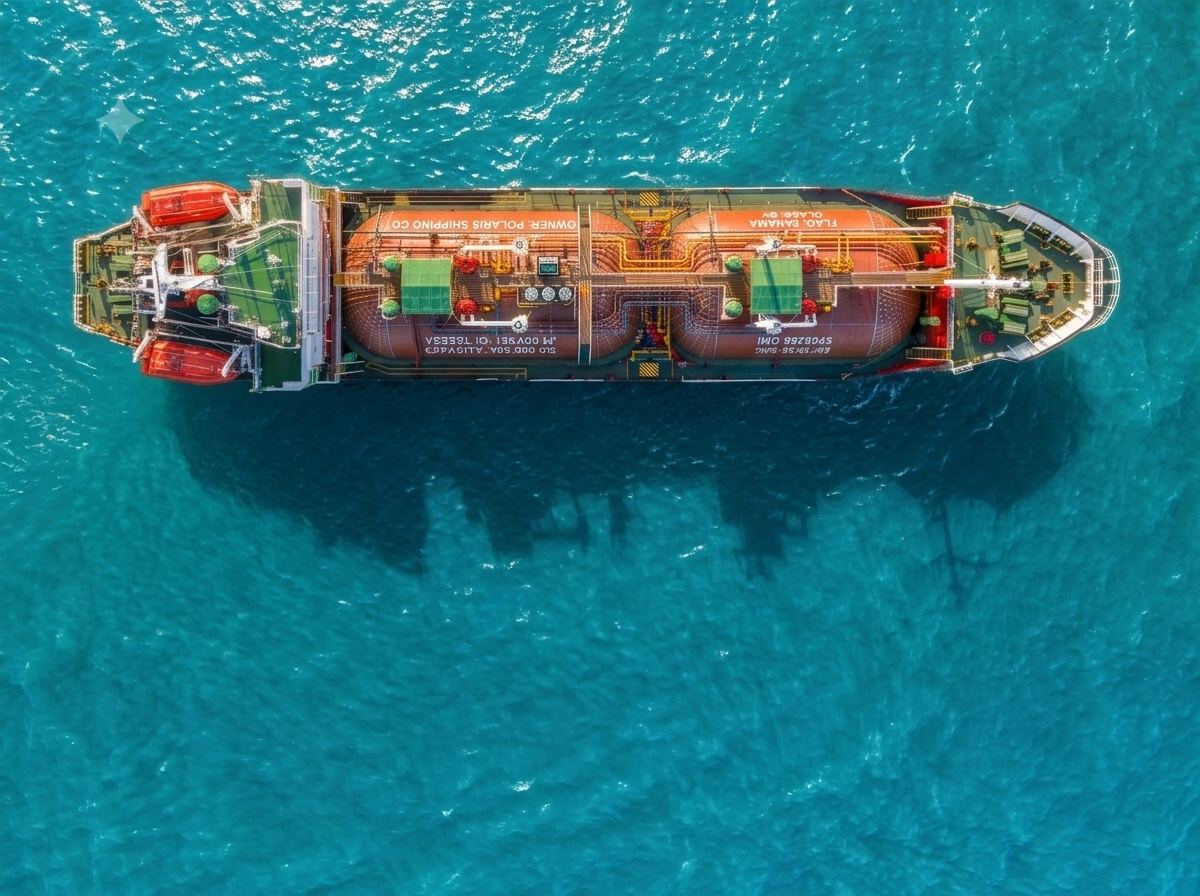
The infrastructure of global gas mobility
Transporting liquefied natural gas and liquefied petroleum gas across global energy systems
Classes
Distinct vessel categories defined by size, design and operational purpose.
Cargo
Representative major bulk commodities carried on long-haul trades.
Fleet size
Total number of vessels available within the global shipping fleet.
Trade
Approximate annual dry bulk cargo moved by sea.
Role in global trade
LNG and LPG shipping enables the global trade of gaseous hydrocarbons by converting them into liquid form for transportation at low temperature (LNG) or moderate pressure (LPG). This transformation allows natural gas and natural gas liquids to be transported efficiently across long distances where pipelines are not feasible.
The sector is structurally linked to the global energy transition, as it enables gas to be traded as a flexible, globally arbitraged commodity rather than a regionally constrained resource.
Market structure and segmentation
LNG carriers
Q-Max / Q-Flex: The largest LNG carriers, primarily deployed on long-haul routes such as Qatar to Asia and Europe. These vessels achieve maximum economies of scale and are typically tied to long-term charter contracts.
Large LNG carriers (170,000–180,000 m³): The global standard for long-haul LNG trade. They operate across Atlantic and Pacific basins and form the core of the global LNG fleet.
Mid-sized LNG carriers (125,000–160,000 m³): More flexible vessels capable of accessing a wider range of terminals, increasingly used in portfolio trading and spot market optimization.
Small-scale LNG carriers (<60,000 m³): Used for regional distribution, bunkering, and emerging small-scale LNG infrastructure.
LPG carriers
VLGC (Very Large Gas Carrier): The largest LNG carriers, primarily deployed on long-haul routes such as Qatar to Asia and Europe. These vessels achieve maximum economies of scale and are typically tied to long-term charter contracts.
MGC (Medium Gas Carrier): More flexible vessels operating on regional and mid-haul routes, often serving chemical and petrochemical demand centers.
Pressurized and semi-refrigerated carriers: Smaller vessels used for regional distribution, short-haul trades, and ports with limited infrastructure.
Cargo dynamics
LNG (Liquefied Natural Gas): Natural gas cooled to -162°C for transport. Used in power generation, heating, and industrial applications. Demand is increasingly driven by energy security, coal-to-gas switching, and LNG’s role as a flexible transition fuel.
LPG (Liquefied Petroleum Gas): A mix of propane and butane extracted from natural gas processing and oil refining. LPG is widely used in residential energy, petrochemical feedstock, and industrial applications.
Emerging cargoes: Ammonia is increasingly discussed as a future energy carrier, particularly in decarbonization pathways, though volumes remain limited.
Earnings drivers and cycle dynamics
LNG and LPG shipping earnings are driven by global supply-demand imbalances in gas production, liquefaction capacity, and regional demand, combined with the cost arbitrage between sourcing regions.
Unlike dry bulk or tankers, liquefied gas shipping is heavily influenced by infrastructure constraints, including liquefaction plants, regasification terminals, and storage capacity.
Demand is highly seasonal and sensitive to weather patterns, storage levels, and energy substitution effects (coal-to-gas switching or gas-to-renewables displacement).
Supply is determined by vessel availability, liquefaction-linked long-term contracts, and the pace of newbuilding deliveries, which are typically ordered years in advance and closely tied to LNG project development cycles.
Investor lens
What the market often misprices
LNG and LPG shipping is often viewed as a pure energy demand proxy. In reality, returns are primarily driven by infrastructure bottlenecks, arbitrage opportunities, and long-haul trade displacement rather than absolute consumption.
Key leading indicators
- LNG and LPG spot freight rates
- FID activity in upstream gas projects
- Charter rates and term coverage ratios
- Storage levels in major consuming regions
- Atlantic–Pacific price spreads (JKM, TTF, Henry Hub)
Where optionality lies
- Long-haul arbitrage expansion (U.S. and Qatar exports)
- Reconfiguration of European gas supply chains
- Seasonal demand spikes and winter shortages
- Expansion of small-scale LNG and bunkering markets
Structural risks
- Long-term displacement of gas in energy mix
- Overbuild of liquefaction capacity
- Transition uncertainty affecting long-dated contracting cycles
Other Asset Classes
Dry Bulk
Vessels designed to transport unpackaged major bulks (iron ore, coal, grain) and minor bulks worldwide — the most cost-efficient mode for commodity flows tied to steel, energy, and agriculture. Freight reflects global supply and demand and tonne-mile trade patterns.
Tankers
Liquid cargo carriers transporting crude oil, refined petroleum products and chemicals across global trade routes. Generating revenue through short or long term charter contracts with oil majors, refiners and energy traders.
Containerships
Ships moving manufactured goods in standardized containers on fixed routes. Yielding income through service contracts with liner companies, forwarders and major retailers worldwide.
Latest
Helm Insights
Market analysis, investment perspectives and shipping fundamentals. Built for investors.

8 Themes Shaping the Markets in 2026
Key players across the value chain

How to assess quality in maritime investment